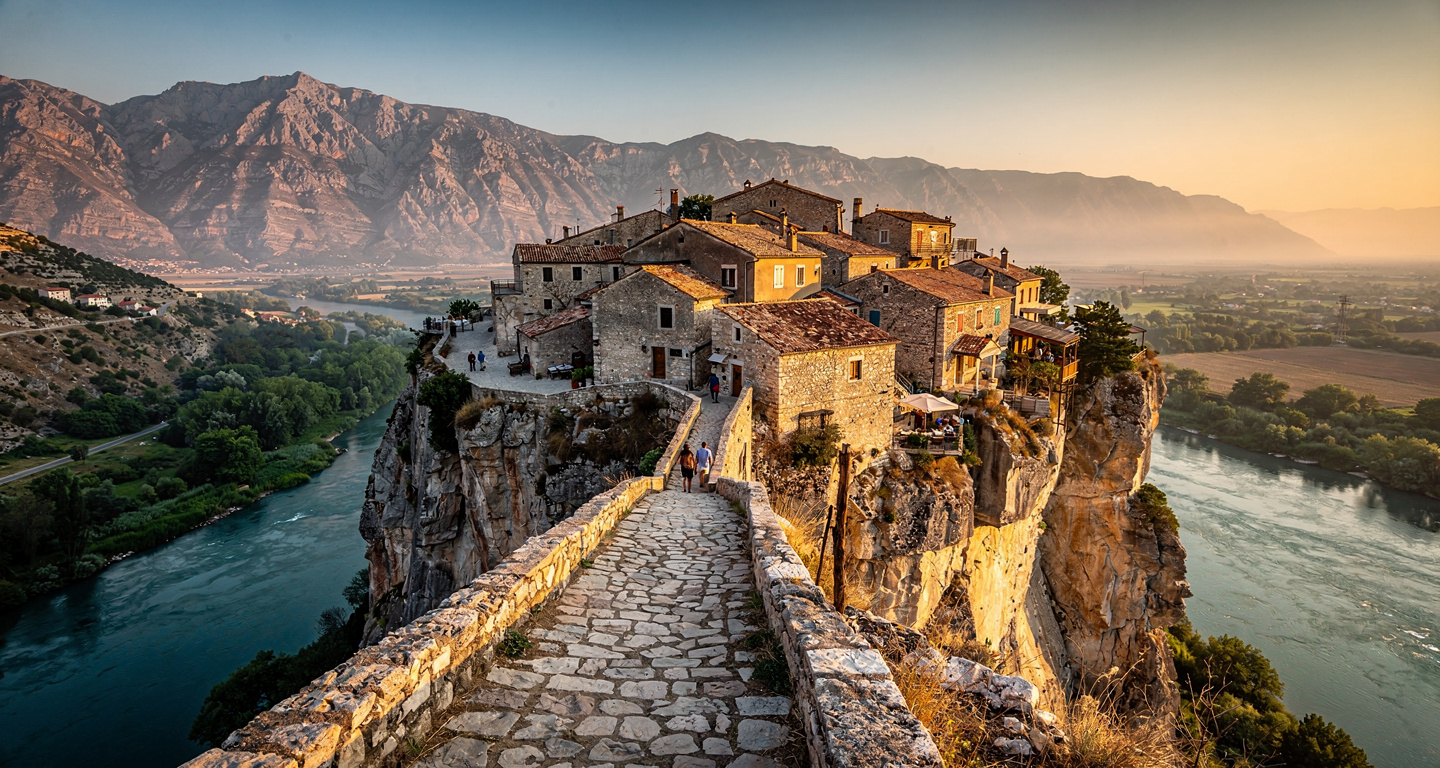
Everyone has a travel bucket list. And most of those lists look the same: Paris, Bali, New York, the Amalfi Coast. These are wonderful places—genuinely, no argument—but when you're elbow-to-elbow at the Trevi Fountain with four thousand other people all trying to get the same Instagram shot, something essential about travel gets lost in the shuffle. The world is enormous and absurdly varied, and some of its most extraordinary places are sitting there, waiting, with good food and fewer crowds and locals who are genuinely delighted to meet you.
Here are five destinations where that version of travel still exists.
Georgia (the Country): Where the Caucasus Meets Ancient Wine Culture
Let me set the scene: you're sitting at a long wooden table in a hillside village outside Tbilisi, an old man whose name you can't quite pronounce is filling your clay cup with amber-colored wine made in a clay pot buried in the earth, and someone's grandmother has just emerged from the kitchen with a tray of khinkali—those magnificent soup dumplings that will ruin you for other dumplings forever. This is Georgia on an average Tuesday.
The Republic of Georgia sits at the crossroads of Europe and Asia, bordered by the Caucasus Mountains to the north and the Black Sea to the west. It's one of the oldest wine regions on earth—8,000 years of viticulture, with a natural winemaking method using clay qvevri vessels that UNESCO actually deemed intangible cultural heritage. The food alone is worth the plane ticket.
Tbilisi: The City That Time Assembled in Layers
Tbilisi is architecturally bizarre in the best possible way—Persian-influenced wooden balconies cantilevered over narrow alleys in the Old Town, Soviet Brutalism looming a few blocks away, and the glass-and-steel bridge over the Mtkvari River that looks like it belongs in a different century entirely. It's a city that never quite agreed on a style and is better for it.
The Abanotubani sulfur bath district in the old town is genuinely unmissable. The domed bathhouses draw naturally heated sulfur water—slightly yellow, smelling faintly of eggs in a way that sounds off-putting but isn't—and a private room for an hour costs around 15-25 USD. Get the full scrub-and-massage. You'll walk out feeling like a different person.
The Narikala Fortress overlooking the city is free and the view from the walls at sunset—pink light hitting the old town below, the river catching it—will make you forget every city view you thought you'd seen.
The Caucasus Mountains: Kazbegi and the Church on the Edge of Everything
Three hours north of Tbilisi by marshrutka (shared minibus, $3), the village of Kazbegi sits at 1,740 meters with the Gergeti Trinity Church perched on a hilltop above it at 2,170 meters, backdropped by Mount Kazbek's 5,047-meter peak. The hike up takes about 90 minutes and is worth every breath.
What a trip costs: Budget travelers can manage $40-50/day including accommodation, food, and transport. Georgia is extraordinarily affordable by European standards.
When to go: May-June and September-October for shoulder season weather without summer crowds. Winters in Tbilisi are mild; mountain regions get serious snow.
Getting there: Direct flights to Tbilisi from many European hubs, or via Istanbul or Dubai from North America.
Malta: Three Islands of Limestone, Knights, and Impossibly Blue Water
Malta keeps coming up in conversations among travelers who've been everywhere and are still surprised by it. The entire country is smaller than Chicago, but it packs in 7,000 years of history, medieval fortifications, a capital city (Valletta) that UNESCO calls an outstanding universal monument, and water so extraordinarily blue it looks color-corrected.
The strategic position of these limestone islands in the central Mediterranean meant that every civilization with naval ambitions—Phoenicians, Romans, Arabs, Normans, Knights of St. John, Napoleon, the British—passed through and left something behind. The resulting cultural layering is dense and fascinating.
Valletta: The World's Smallest Capital With Outsized Grandeur
Valletta was purpose-built in 1566 by the Knights of St. John after the Great Siege of Malta, and every street grid and fortification reflects that military planning. Walking through the bastions at the tip of the peninsula with views of the Grand Harbour on both sides is one of the great European urban experiences.
The St. John's Co-Cathedral interior will stop you cold—the entire floor is a mosaic of 400 marble tombstones of deceased knights, and the Caravaggio paintings in the oratory are two of the best he ever made. Admission is around €15.
The neighborhood of Valletta's Strait Street (historically the sailors' quarter, now full of wine bars and jazz venues) comes alive after 9 PM. Order a Kinnie—a bittersweet Maltese soft drink made from bitter oranges—and find a seat outside.
Comino and the Blue Lagoon (Plus How to See It Without the Crowds)
Comino is a tiny uninhabited island between Malta and the sister island of Gozo, and its Blue Lagoon is legitimately one of the most beautiful bodies of water in the Mediterranean—turquoise shallows over white sand, surrounded by limestone cliffs. It's also absolutely overrun with tourists from June through August.
The solution: go early or go late. Day-trippers arrive mid-morning; if you're on the water by 8 AM, you'll have the lagoon largely to yourself. A Malta coastline cruise that takes in Comino, the Blue Lagoon, and the Crystal Lagoon starts at around $34 USD—check current rates and availability here. For something more intimate, private boat charters to the Blue Lagoon and Gozo start around $215 for a small group and give you the flexibility to anchor wherever the tour boats aren't.
What a trip costs: Malta is mid-range by Mediterranean standards. Budget €80-120/day for accommodation, food, and activities. It's cheaper than Italy with comparable (sometimes better) food and history.
When to go: April-May and October-November. Summers are hot and crowded; winters are mild but some boat tours run reduced schedules.
Getting there: Ryanair, Air Malta, and other carriers connect Malta to major European hubs. No direct flights from North America—route via London, Rome, or Frankfurt.
Oman: The Arabian Peninsula Without the Performance
The Gulf has become synonymous with scale—tallest buildings, biggest malls, maximum spectacle. Oman quietly ignores all of this and offers something the rest of the region largely doesn't: an Arabia that feels authentic rather than constructed. The Sultanate has preserved both its architecture and its culture with unusual care, and the landscape—from the dramatic wadis (canyon valleys) to the dunes of the Wahiba Sands to the frankincense-scented Dhofar region—is extraordinary.
The Omanis are also, without exaggeration, among the most genuinely hospitable people I've encountered anywhere. Accepting an invitation for coffee and dates is not optional; it's how introductions work, and it's genuinely meant.
Muscat: Elegant, Low-Rise, and Refreshingly Unbothered
Muscat spreads along a dramatic rocky coastline and has resisted the high-rise temptation that transformed Dubai and Abu Dhabi. Building heights are controlled, the Al Alam Palace sits modestly at the waterfront, and the Mutrah Souq is a working, breathing market rather than a tourist simulation. The smell of frankincense and rose water hangs in the corridors; the shopkeepers will talk to you about their families before mentioning what they're selling.
The Sultan Qaboos Grand Mosque is one of the most beautiful Islamic buildings I've ever stood inside—the main prayer hall chandelier is 14 meters tall, the Persian carpet took four years to weave, and non-Muslim visitors are welcome outside prayer times. Women need to cover up (scarves are available at the entrance).
The Wadis and Desert: Where Oman Earns Its Reputation
The landscape outside Muscat is where the country becomes genuinely spectacular. Wadi Bani Khalid is a canyon with crystal-clear natural pools fed by underground springs—the water is bracingly cold, the limestone walls are dramatic, and the date palms growing along the banks complete the picture. A full-day private tour combining Wadi Bani Khalid with the Wahiba Sands desert for a sunset camel ride runs around $190 USD per vehicle—see current rates here.
Wadi Shab is the more dramatic option—a longer hike through a canyon gorge with deep swimming pools, culminating (if you want it to) in squeezing through a narrow tunnel into a cave with a waterfall inside. Private full-day tours to Wadi Shab and the nearby Bimmah Sinkhole (a collapsed limestone cave that's now a natural pool) start around $165 USD—details here.
What a trip costs: Oman is moderately priced by Gulf standards. Budget $100-150/day for mid-range travel. The private tours are worth it; public transport to the wadis is complicated.
When to go: October through March. Summer temperatures regularly exceed 45°C (113°F). The Dhofar region (Salalah) reverses this pattern—it gets a monsoon season in July-August that turns the landscape lush and green.
Getting there: Oman Air, Emirates, and Qatar Airways connect Muscat to major hubs. The country offers visa-on-arrival for most Western passport holders.
The Faroe Islands: Dramatic, Remote, and Worth the Logistics
Eighteen islands in the North Atlantic, equidistant between Norway and Iceland, with 50,000 people, 80,000 sheep, no trees, and a landscape of sheer cliffs dropping into churning sea that looks like something a special-effects team designed for a fantasy film. The Faroe Islands are genuinely unlike anywhere else.
The light here does something strange. In summer, the sun barely sets, and the long golden hours turn the grass an almost artificial green against the black basalt cliffs. In winter, the islands are dark and moody and dramatic in a completely different way.
What You're Actually Going For
Gásadalur is the poster-child village—a handful of houses above a waterfall that drops directly into the ocean, ringed by mountains. It was only connected to the rest of the islands by a road tunnel in 2004; before that, residents hiked over the mountain or took a boat.
Sørvágsvatn Lake sits above the ocean at what appears to be an impossible angle—photographs make it look suspended over the sea. The reality is a visual trick of elevation and perspective, but standing there in person, the illusion holds.
The puffin colonies on the island of Mykines (a short ferry and a moderate hike) are one of those rare wildlife experiences that exceeds expectations. You can sit in the grass two feet from a puffin who regards you with complete indifference.
What a trip costs: The Faroe Islands are expensive. Budget $200-300/day including accommodation (limited options; book months ahead), food, and transport. Self-catering accommodation in traditional turf-roof houses brings costs down significantly.
When to go: June and July for long light and puffin season. September for dramatic weather and fewer visitors. Come prepared for all four seasons in a single day regardless of when you go.
Getting there: Atlantic Airways flies from Copenhagen and a handful of other European cities. There are also ferry connections from Denmark, though they take 36 hours.
Tbilisi Again: A Note on What These Places Have in Common
Reading back through this list, I notice what connects these destinations. They all require a bit more effort than booking a package tour to Barcelona. The logistics are less frictionless. The language barriers are more real. The tourist infrastructure is thinner.
And in each case, that's exactly the point. The infrastructure that makes travel frictionless—the same hotels, the same menus translated into six languages, the same souvenir shops—also makes places feel interchangeable. When you're somewhere that hasn't fully optimized itself for visitors yet, the edges are still there. The real thing is still what you encounter.
The retired teacher showing you her kitchen in Kazbegi doesn't know she's performing local color for your travel blog. She's just making chakapuli (lamb stew with tarragon) because it's what she makes on Thursday. The old man in the Muscat souq pouring coffee isn't doing it for your experience; he's doing it because that's how you greet a stranger.
Those moments are what travel used to feel like everywhere. They still exist. You just have to go where the crowds haven't fully arrived yet—and get there before they do.
Tours and activity prices are listed in USD and subject to change. Always verify current rates and availability at booking.